


Helen Jackson: What I discovered visiting a basket maker in Scotland


Helen Jackson’s home is filled with baskets. Small willow baskets sit on shelves and tables, their presence woven into the everyday life of the house. They are beautiful, but they are also useful, made to hold and contain the things we need.
Helen comes from a traditional basketry background, working with willow to create beautifully crafted pieces. Yet alongside this established practice she has developed a quieter, more intimate exploration of plant fibres, using a single traditional form as the starting point for a remarkable range of experiments.
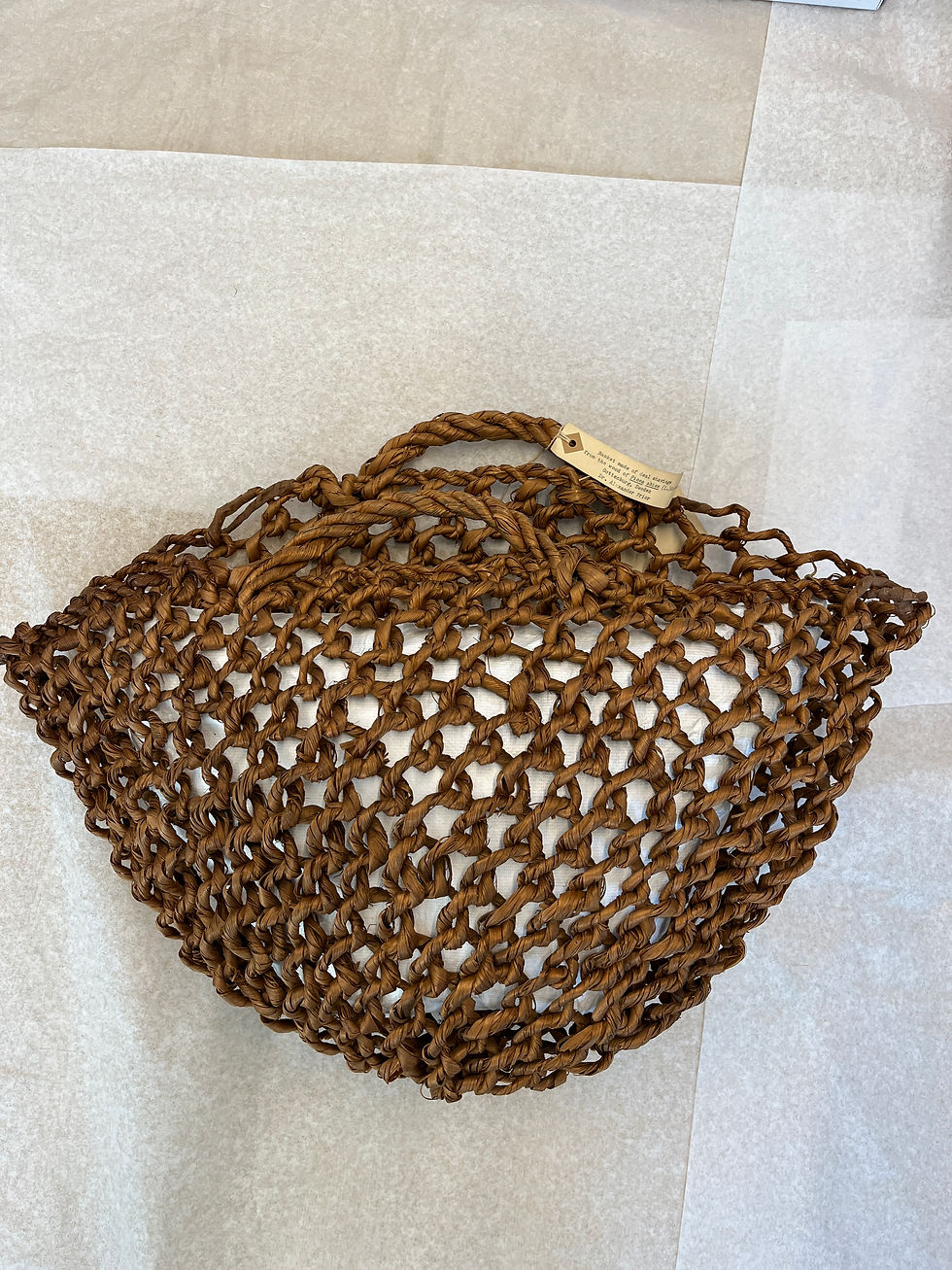
Her interest lies in the Kishie, a traditional Scottish style of basket which she has reinterpreted in miniature, making small, delicate forms from an extraordinary variety of plants. Most measure only ten to fifteen centimetres but within these modest dimensions is a world of discovery.
Looking more closely

During my visit, I was struck by the sheer number of different fibres Helen uses. At the end of the day we walked down the lane near her home. As we moved along, she pointed out plants I might easily have overlooked; grasses, sedges and other seemingly insignificant growths. For Helen, the landscape is full of possibilities. A plant does not need to be large or particularly conspicuous to offer something useful for making.
Her collection of prepared fibres and handmade cordage reveals the extent of this curiosity. Snowdrop, marram grass, willow bark, soft rush, bramble, corn husk, rosebay willow-herb, beech grass and hyacinth were among the materials she showed me. There were also dandelion, hair moss, cattail, hemp, tulip leaves, yellow flag iris, crocus leaves, New Zealand flax, hardy geranium and plantain.
The list seemed endless, and these were just some of the fibres she had collected and prepared.
Each plant offers its own qualities. Some can be worked into exceptionally fine cordage; others have a different texture, strength or character. The challenge is to recognise these possibilities and discover how a particular fibre might behave. Helen’s practice involves looking closely, gathering thoughtfully and experimenting with what each plant can offer.
Walking with her, I began to understand that this is not simply a matter of collecting materials. It is a way of seeing the landscape differently. Plants that might otherwise pass unnoticed become potential sources of colour, texture and structure.
The Kishie as a starting point

The collection of small Kishie-style baskets Helen showed me was exquisite. Each one explored the same basic form, yet the differences between them were remarkable. Made from broom, plantain, heather, lavender, yarrow, rosebay willowherb, bell heather, strawberry runners, dandelion, sedges and other gathered plants, they demonstrated just how much variation can be found within a single basketry technique.
Some were rustic in appearance, with flowers or other plant details incorporated into their structure. Others were so fine and delicate that they seemed almost fragile. The plantain basket particularly caught my attention, as did the strawberry runner, a material I had not previously considered in this way.
What I found compelling was the consistency of the form alongside the diversity of the materials. Helen is not searching for a new technique every time she works with a different plant. Instead, she returns to the Kishie, allowing the material itself to lead the exploration. The familiar structure becomes a framework for discovery.
This approach reveals how much there is to learn from working deeply with one technique. By repeating a form, Helen can concentrate on the individual qualities of each fibre, discovering how it responds to being gathered, prepared and woven. The resulting baskets are small, but the thinking behind them is expansive.
These are not baskets made primarily for practical use. Their purpose is to reveal the possibilities of the plants themselves: the subtle differences between fibres, the textures they create and the forms they can sustain. Each is an intimate record of an encounter between maker and material.
Beyond the willow basket

Helen’s experimentation extends beyond the Kishie. Among her work were finely woven, open structures made using an approach similar to the random weaving familiar in basketry with pine inflorescences. One particularly delicate example was made from a palm inflorescence, its upright stems supporting an irregularly woven form beneath.
Other pieces explored plaiting, including beautiful upright structures made using a three-strand plait. These had a sculptural quality, standing somewhere between basket and object. There were also small knitted forms, adding another dimension to her exploration of plant materials and construction.
Although Helen has an extensive collection of willow and continues to work within traditional basketry, she is clearly drawn to the possibilities that emerge when she steps outside its familiar boundaries. Her work moves between the functional basket, the experimental study of a plant fibre and the sculptural object.
It is this willingness to explore that makes her practice so interesting. She does not appear to need to abandon tradition to discover something new. Instead, she uses her knowledge of basketry as a foundation from which to investigate the materials around her.
An instinctive connection with nature

When I asked Helen what plant fibres meant to her, she spoke about nature as her inspiration. There was a sense that working with plants was not simply an interest she had developed, but something fundamental to who she is. As she explained, it was almost “in her DNA” that she had to do it.
I was interested in this sense of compulsion: the need to make, to explore and to keep looking. It is something I have encountered in conversations with other fibre artists, and it raises an interesting question about our relationship with the natural world. Perhaps inspiration is not always about finding a particular plant or responding to a dramatic landscape. Sometimes it is the desire to be outside, to notice what is growing and to discover what might be possible with the smallest piece of material.
Helen’s work brings this relationship into focus. Her baskets encourage us to look again at plants we might ordinarily ignore. A grass, a flower stem or a strawberry runner can become something quite unexpected when it passes through the hands of a maker who understands how to work with it.

What stays with me from my visit is the extraordinary range of possibilities Helen finds in the landscape around her. Her small Kishie-style baskets are delicate, thoughtful explorations of individual plants, each one revealing a little more about the material from which it is made.
In Helen’s hands, basketry becomes a way of paying attention. The traditional form remains, but the possibilities are continually renewed by the plants she discovers and the fibres she is compelled to explore.
I encourage you to explore Helen's website here.


Comments