


Where the land becomes the work: Kate Sankey at West Moss-side

Updated: Sep 29
Ruth Woods and Kate Sankey
From left to right: Signage to the West Moss-side Farm; Ruth Woods & Kate Sankey.
There are some places where it is difficult to separate the maker from the landscape around them. West Moss-side is one of those places.
I visited Kate Sankey at her farm and studio beside Flanders Moss in Scotland, expecting to talk about natural basketry. And we did. But very quickly it became clear that Kate's work is part of a much bigger story, one that stretches across more than 30 years and brings together farming, conservation, natural materials, heritage and making.
When Kate first arrived, the land was predominantly pasture, used for sheep and growing grass for hay and silage. There were few trees and hedges, little riverside vegetation and not much in the way of wildlife corridors.
Her intention from the beginning was to bring biodiversity back. She planted trees and along the river, around a thousand willow cuttings, originally for the land and wildlife rather than for basketmaking.
Years later, those decisions have created habitat for an extraordinary range of wildlife, including water voles, otters and more recently, beavers. And somewhere along the way, all that willow presented Kate with another possibility.
From left to right: Willow growing as part of of Kate’s bio diverse land; stripped willow bark.
From growing willow to natural basketry
Kate had grown up in Bristol and lived in Somerset, so willow and basketmaking were already somewhere in the back of her mind. With all that willow now growing on the farm, she decided she ought to learn what to do with it.
A short basketmaking course was the beginning. From there came workshops, other makers and the Scottish Basketmakers' Circle, where Kate was exposed to an enormous range of techniques and traditions.
Kate kept learning from makers working with willow, bark, rushes and other plant fibres, exploring traditional techniques and encountering basketmaking traditions from other parts of the world. But she isn't interested in simply reproducing somebody else's tradition.
Instead, she asks: what does this technique become here?
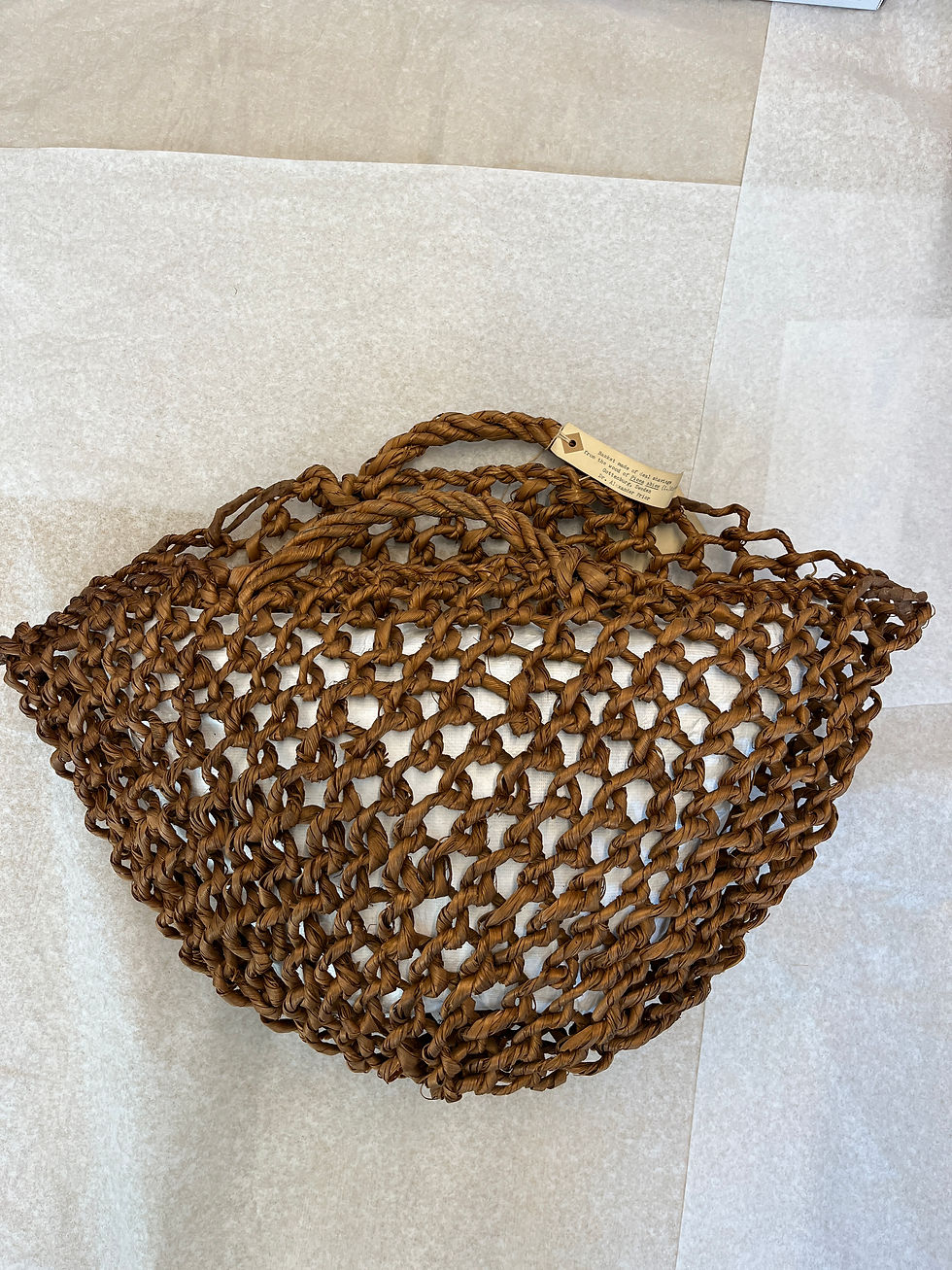
At West Moss-side, that might mean learning to braid a basket using river rush, then returning home and trying the same principle with the soft rush growing abundantly in her own fields. Or learning about bark weaving and exploring what can be done with the willow bark she has around her.
This approach to natural basketry is shaped as much by what grows at West Moss-side as it is by the techniques Kate has learnt.
Above: Kate Sankey’s willow bark pouches.
Making with what grows around you
Walk across West Moss-side and many of the plants surrounding you have found their way into Kate's work. There is willow, of course, but also soft rush, cotton grass, mosses and other plants from the surrounding landscape.
Some have uses stretching back hundreds of years. Plants we might now walk past without a second thought were once materials people understood intimately, knowing which could become cordage, which could be woven and which were useful for particular kinds of basketry.
Kate tells the story of having a bee skep maker visit West Moss-side to teach a course. When she took him onto the moss, he immediately recognised purple moor grass as an excellent material for making traditional bee skeps.
Without his particular knowledge, she may never have known. It is one small example of knowledge that can disappear surprisingly quickly when the connection between people, craft and place is lost.
For Kate, rediscovering those connections has become part of her approach to natural basketry.
Left to right: Hanging plant fibre; Bee skep in progress; Hanging plant fibre
A landscape built in layers
Flanders Moss has also influenced Kate visually. The raised bog beside the farm has formed over thousands of years, with layers of peat, dark earth and extraordinarily bright vegetation creating contrasts that appear again in the textures and forms of her work.
Kate talks about layering often. There are the physical layers of the peat itself, but also layers of history, accumulated knowledge and human relationships with the landscape.
There is another layer too: respect.
Through meeting and learning from makers from different cultures and traditions, Kate has become increasingly conscious that basketry techniques are not simply decorative ideas waiting to be borrowed. They belong to people, histories and places.
Her response has been to learn from those encounters while continuing to ask what natural basketry means in her own place. For Kate, walking out onto Flanders Moss in the morning provides that connection, and the result is work that feels unmistakably tied to West Moss-side.
Left to right: Kate Sankey's home; Kate's studio.
The farm itself is part of the practice
Basketmaking is only one part of life here. Kate also keeps Shetland cattle, a traditional breed from the Shetland Islands that was seriously endangered when she first began keeping them more than 20 years ago.
She didn't originally choose them because they were rare. She needed cattle suited to very wet ground, easy to handle and able to calve reliably.
They turned out to be remarkably well suited to conservation grazing. Small and light, with surprisingly large feet, they can move across wet ground with less damage than heavier cattle, grazing rough grasses and young birch growth around the bog.
That connection between the practical and the ecological seems to repeat itself everywhere at West Moss-side. The willow provides habitat and material for natural basketry, the cattle provide food and conservation grazing, plants become cordage and baskets, and old farm buildings become studios and gathering places.
Nothing sits entirely on its own.
Left to right: Stripped willow bark.
A place to make and learn
The beautiful studio we visited wasn't part of some carefully mapped-out career plan. Its beginnings came after a major change in Kate's life.
In 2003, her relationship ended. At the time she was working full-time at the University of Stirling while also running the farm. Eventually she decided to leave her university job and concentrate on creating the life and place she wanted around her.
The studio began simply as somewhere for Kate to work. Then came a renovated hayloft and courses taught by other makers, with basketmakers joined by felters, woodcarvers and other craftspeople.
Over time, West Moss-side became not only a farm and Kate's workplace, but somewhere other people could come to make, learn and exchange knowledge. Today that creative community extends through local artists and open studio events, giving visitors the opportunity to see the work, meet makers and hear the stories behind what they create.
Still learning from the land
One of the most interesting things about visiting West Moss-side is that there isn't a neat dividing line between conservation, farming and art. They have grown together.
What began as the restoration of fairly ordinary farmland has developed over decades into a richly diverse place that supports wildlife, provides materials, produces food and inspires creative work. Natural basketry is one expression of that relationship.
And Kate is still experimenting, with new basketry techniques to explore, different plants to test and new ways of using what is already growing around her.
Perhaps that's fitting. A landscape is never really finished either. It grows and changes, and sometimes something planted decades ago for one reason becomes important for an entirely different one.
At West Moss-side, Kate has created a life where those discoveries have room to happen, and through her natural basketry, a little of that landscape travels with every piece she makes.
To discover more about Kate's natural basketry, the story of West Moss-side and the creative life of the farm, visit West Moss-side.
Left to right: Cordage made from Hair Moss Polytricum; Scarf made using Hair moss and knitted moss stitch.


Such a good story, lovely to have such a wide range of history to fill in the gaps of skills ,fibre and land. I also set out to create a bio diverse landscape as part of orchards from a very degraded blackberry dominated landscape. The need (or love) of harvest baskets, plants and landscape inspired the first of many woven works either for the garden, harvest , house or pleasure.