


Two days at Kew: plants, baskets and a remarkable collection

Visiting Kew Gardens had been something I was looking forward to for a long time, but I don't think I could have anticipated quite how much these two days would give me.
There were, of course, the gardens themselves and those magnificent glasshouses. But there was also an opportunity to go behind the scenes and spend time looking closely at Kew's basketry collection, talking about plant fibres, techniques, history and the importance of preserving the stories that sit alongside these objects.
It turned into two very different days at Kew.
A slightly soggy beginning
My first morning in Kew began with constant rain.
Armed with my brolly and the new coat I'd bought for the trip, I set off down the road, promptly slipped on a banana skin and went flat on my face into a puddle.
A hole in my knee, soaking wet clothes and one walk back to the B&B later, I changed and started again.
Not quite the elegant beginning I had imagined.
After breakfast, I finally made my way to Kew Gardens.
The UK had been through a very dry period, particularly in the south, and you could see it in the gardens. Some of the trees and plants looked scorched and tired, with shrivelled leaves, although the rain certainly seemed to be appreciated.
I decided the best way to begin was to take the little train around the gardens, get my bearings and work out where I wanted to spend my time.
There were two places particularly high on my list: the Palm House and the Temperate House.
Inside Kew's extraordinary glasshouses
The Palm House The Palm House
The Palm House - Kew Gardens
The Palm House was my first stop, and it was absolutely stunning.
But it was the Temperate House that really took my breath away.
The scale of the building is extraordinary. Inside, a spiral staircase takes you high into the glasshouse, where you can walk around above the plants and look down into the collection below.
For someone interested in plants and plant fibres, there was so much to take in.
What surprised me was how many plants I recognised.
Sometimes I don't think of myself as knowing a great number of plants, but as I walked around I kept spotting species I knew, particularly plants that grow in Australia and some that we use in weaving.
There is something quite special about seeing a familiar plant growing on the other side of the world and immediately understanding it through the material or fibre it can provide.
And Kew offered a few other unexpected encounters too.
At one point I spotted a tiny mouse on a grevillea, the same type of plant I grow at home, eating nectar from one of the flowers. I had never seen anything quite like it.
Later, walking through the parkland, I came surprisingly close to a fox that was simply sitting there watching the world go by.
Between the plants, the architecture, the wildlife and an extremely tempting collection of books in the Kew gift shop, it was quite a day.
But the following day was the one I had particularly travelled to Kew for.
Behind the scenes at Kew
My second visit was very different.

I had arranged to meet Erin Messinger and Ruth Stungo to talk about plants, fibre and basketry and to see some of Kew's collection. Mark Nesbit had very kindly helped organise the visit, and I felt incredibly privileged to have the opportunity.
I arrived at the Herbarium at 10 o'clock and met Erin in the Economic Botany department.
Waiting for me was a trolley containing around 20 baskets I had selected to examine. Each had been carefully wrapped or boxed and prepared for my visit.
For a basket maker, it was a rather exciting sight.
When Ruth arrived after her long journey from the other side of London, the conversation quickly moved into the sort of wonderfully detailed territory that happens when people with a shared fascination start talking.
Ruth brings together two areas beautifully. She is both a botanist and a basket maker, and has spent many years studying the baskets within the Kew collection.
Kew holds more than 1,000 baskets, and many of the older catalogue records have historically contained very little information.

Ruth told me that one basket had once been described simply as being made from a "collection of sticks".
Of course, we know a basket is much more than that.
What plant was used? Where did it come from? How was the material prepared? What technique was used? Where was the basket made and what was it used for?
These details matter.
Over the years, Ruth has worked to add more of that information wherever possible, helping build a much richer understanding of the objects in the collection.
More than a basket
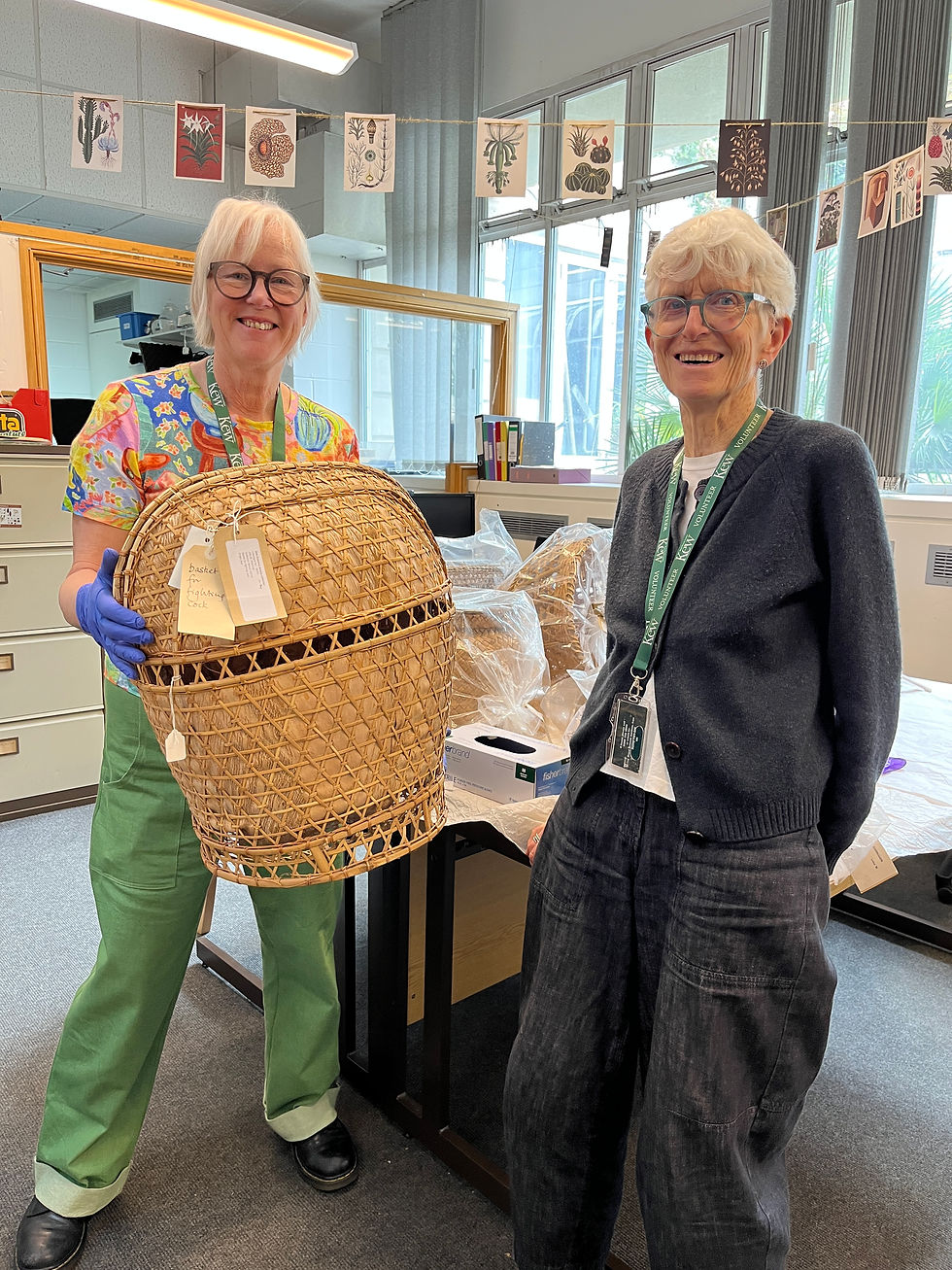
That beautiful conversation stayed with me throughout the day.
When we look at a basket, it is easy to focus purely on the finished object.
But every basket also contains information.
It can tell us about the plants growing in a particular place, the way people understood and processed those plants, techniques handed from one generation to another, cultural traditions, practical needs and individual creativity.
The plant and the basket are part of the same story.
We talked about fibres and baskets from Australia, New Zealand, South America and many other parts of the world.
There were also some lovely connections back to people and places I already knew through my own research and travels. As we talked, familiar names and experiences appeared, reinforcing just how connected this world of basketry really is.
Exploring the collection

After lunch, Ruth left and I continued looking through the collection with Erin.
I was able to do some filming, including inside the collection room itself.
This was another memorable experience.
The collection is stored on those wonderful moving shelving systems that roll backwards and forwards, allowing access to row after row of objects.
There was so much to see.
At one point Erin was searching for a particular snail carrier basket. I had already noticed another piece that reminded me of the work of basket maker Tim Johnson and, rather wonderfully, the object I had picked out turned out to be the snail basket we had been looking for.
It was one of those small coincidences that made an already fascinating day even more enjoyable.
Preserving knowledge as well as objects
One of the things I came away thinking about was the importance of collections like this.
Preserving the physical object is only one part of the job.
The knowledge attached to it matters just as much.
Without information about materials, techniques, makers, origins and uses, we can lose much of what makes an object significant.
Digitisation is making it possible for collections and information to be preserved and shared much more widely, but a database can only contain the knowledge that someone has taken the time to record.
That makes the work of researchers, botanists, makers, curators and people who understand these techniques incredibly important.
I also loved the generosity behind the whole experience.
This wasn't about keeping knowledge hidden away.
It was about connection, collaboration and sharing what is known so that these objects, techniques and stories aren't forgotten.
From left to right: Looped bag - pine bark; Rooster basket - cane and palm fibre; Kishie (Scottish basket).
Where the research leads next
By the end of the visit I had spent around five hours talking, looking, filming and absorbing information.
I was exhausted, but in the best possible way.
I'm still not entirely sure how everything I learnt at Kew will find its way into my own work and the book I'm developing.
Perhaps it will influence the techniques I include. Perhaps it will change the way I think about particular fibres. Or perhaps some of the value will simply come from seeing how these baskets, plants and stories connect across countries and generations.
That's one of the pleasures of research.
You don't necessarily know what will become important when you first discover it.
Sometimes you simply gather the threads, keep following them and see where they lead.


Comments